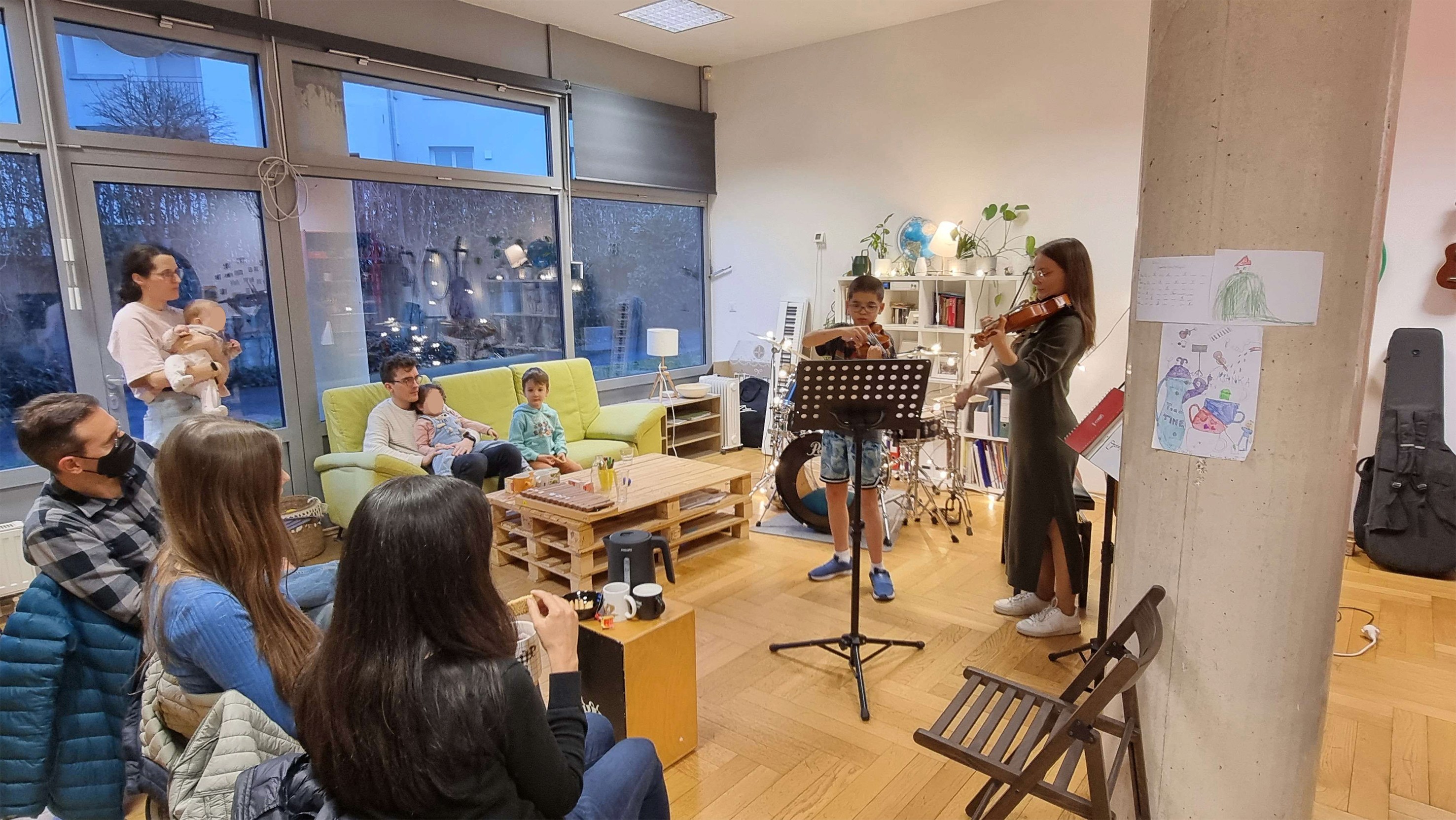
What getting ready for music school actually means
Most of us imagine preparation as a head start in knowledge: we would like to teach the child a few notes, buy an instrument in advance, maybe book a lesson or two so that they do not turn up to the first meeting empty-handed. That is understandable, and largely unnecessary. Notes, posture, technique, fingering - all of that is work the music school will do better than we can, and it is in fact what we are paying it for.
What the school cannot arrange on our behalf is the time between two lessons. In the classroom your child will learn how something is played; at home it will be decided whether they actually know it. So a sensible preparation for music school is really the preparation of two things: a daily habit that has been given a real place in the family week, and listening, which gives the child a sense of how music is supposed to sound before they even try to play it.
In our teaching model, learning music follows the principles of learning a language as described by the Canadian music educator Edwin E. Gordon: everything starts with listening, imitation follows, and mistakes are part of the process. That leads to a very practical piece of advice for the week before enrolment. Pick one song, listen to it every day, and sing it until the child knows it by heart. A child who truly carries one song in their ear is better prepared than a child who knows the names of the notes.
Your child and your household: two preparations, not one
While we prepare the child, we parents often forget the other half of the equation - the household. And it is that half that most often decides how long music lasts. In our piece on the goal of music school we wrote down an uncomfortable number: because of an inactive home environment, as many as 85 % of musical stories end with a dusty instrument. Rarely because the child lacked talent. Far more often because nobody at home ever agreed on who, when and where.
Preparing the household means answering a few purely logistical questions before the first lesson. Who will sit with the child for the first few weeks? What happens on the days when that person gets home late? Where will the instrument stand, and will it have to be moved every time? Do siblings have to be quiet during those minutes, or can they become the audience? What do we do on the day the child refuses? All of these questions will come. The only difference is whether you answer them in advance or in the middle of week three, when the mood is already tense.
The most reliable form of such an agreement is a written, visible family schedule. A decision you make together with your child, rather than for them, holds considerably longer - which is why day one of Prelude is exactly this: you look for slots in the week together, choose them, sign the schedule and stick it somewhere everyone can see. A sheet of paper on the fridge is not bureaucracy; it is the cheapest form of persistence we know.
A place and a time: two decisions that carry the whole year
A place does not mean a room. It means a corner where everything is within reach: the instrument, the music, a pencil, a glass of water, perhaps a chair at the right height. The aim is for the child to get from the decision to the first note in ten seconds. Every step in between - finding the cable, moving the laundry, fetching the folder from another room - is a small friction, and small frictions are what kill a habit, not a shortage of talent. Day two of Prelude is devoted to precisely this: setting up a base camp at home.
The time should be pinned to something that already reliably happens in your day. After the afternoon snack, before dinner, straight after coming home from school. A new task that floats (“so when are we doing it today?”) is almost always lost; a new task attached to an existing rhythm survives. Ten or fifteen minutes a day is plenty at the start. Short and daily beats long and occasional - not least because the child then does not remember music-making as a great effort.
Days three and four round the preparation off with two small tools. The first is a ritual before playing: a small repeatable gesture that tells the body music is about to begin. The second is a reminder that is not a parent's voice. When the child is nudged towards music by a note, a clock or a system of their own, responsibility quietly moves across to them - and that is exactly what music school will expect of them six months from now.
Choosing a first instrument without over-committing
The instrument is the decision easiest to make too quickly and most expensive to correct. So the useful order is the other way round: goal first, instrument second. In our piece on choosing a musical path we suggest the family pick one or two concrete milestones - for example “I accompany my family at celebrations on the guitar” or “I add music to family gatherings on the piano”. Once the milestone is chosen, the list of sensible instruments narrows on its own, without long arguments about which one is more serious.
Then check three very prosaic things about a first instrument. Can it live in your home, given its size and its volume? Can the child physically manage it now, rather than in two years' time? And can you play songs your family knows and likes to sing on it? That third question matters more than it looks: an instrument on which something recognisable appears in the first week earns far more minutes than one that produces nothing but exercises for two months.
And while you are still deciding, do not buy. Renting, borrowing within the family, or an instrument lent by the school all beat a hasty purchase. The first instrument you already own, after all, is your child's voice. A week or two of regular singing will tell you more about how your child responds to rhythm and melody than any catalogue - and without a single euro spent.
What the first weeks of school will ask of the family
First, the plain logistics: a new fixed slot appears in the calendar, plus the journey there and back. Many schools schedule a group lesson alongside the individual one, which means two slots a week rather than one. If you are coordinating several children and several activities, this is the most common breaking point - and the only defence is to write the slots into the family calendar before they arrive, and to look at what has to give way to them.
Then comes the work at home. The teacher will expect the child to arrive at the next lesson having gone over the material - not flawlessly, but having gone over it. Our job in this is not to teach the child music; that is the mentor's work. Our job is to guarantee the time and the place, to be genuinely present during those minutes, and to notice progress. The most useful thing a parent can do is in fact very simple: listen to the end, and say what was different today compared with yesterday.
And then comes the dip. Somewhere between week three and week six the novelty wears off, the child hits the first passage that cannot be solved in five minutes, and music-making loses to everything else for the first time. Plan for that moment now. In Prelude it has a day of its own: on day five the child names their biggest obstacle out loud, because a named obstacle is considerably smaller than undefined resistance. Day six then brings a performance for the people close to them - small, at home, no stage - which gives the habit an outside reason to continue.
A realistic plan for the last weeks before enrolment
If you still have a month, you can divide it like this. Four weeks out, talk about the goal and choose the milestone you are heading for. Three weeks out, settle the place and the time and write the family schedule. Two weeks out, choose one song and listen to it and sing it every day. In the final week, do two things: a small performance for the family, and a short recording that will serve as a comparison six months from now. None of this requires any musical background from the parent.
And if you do not have a month, or if you would rather be walked through the steps, Prelude is exactly this preparation compressed into a single week. Seven days, each with two tasks - one for the habit and one musical - plus a spoken reflection and one proof of the day. Day one, the schedule and choosing a song; day two, the space and listening; day three, the ritual and movement; day four, a system for regularity and the first melody played; day five, the obstacle and consolidation; day six, a performance for friends; day seven, looking back, with a recording of the progress.
Day one is free, which means you can do the most important part of the preparation - the schedule and the chosen song - today, and only then judge whether to carry on. Whatever you decide, a week of music-making at home before enrolment will answer a question no application form asks: is music currently a resident or a guest in your home? In the first months of music school you will need that answer more than anything else.